
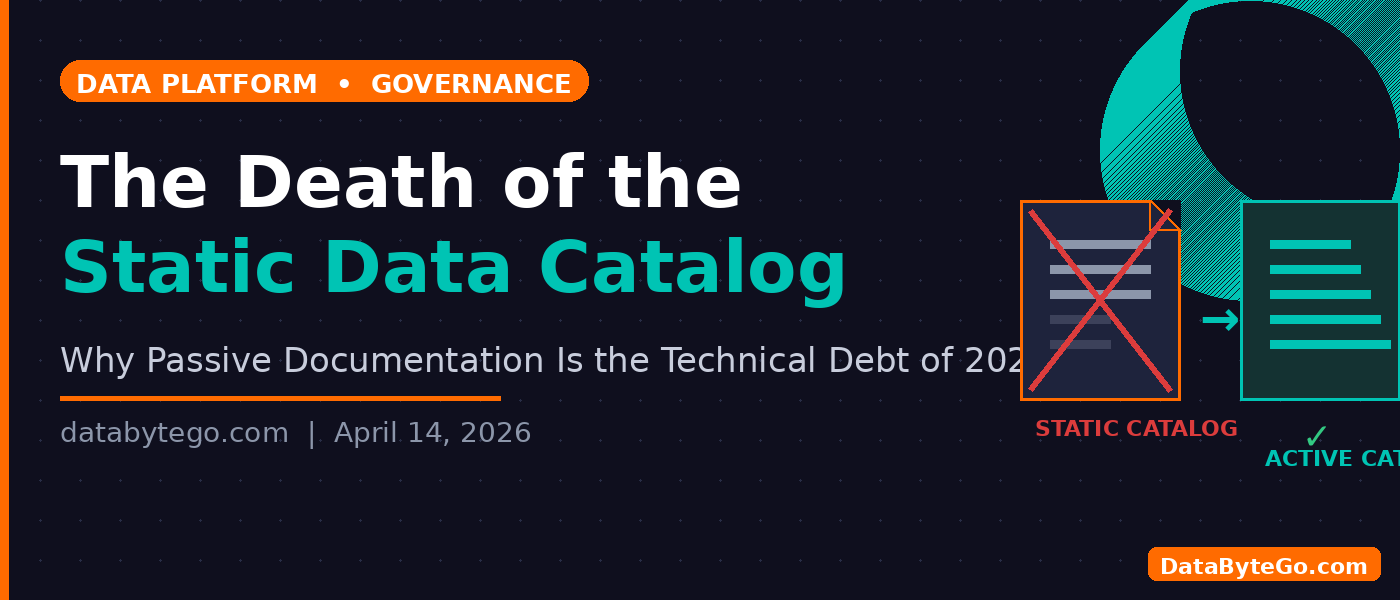
The Death of the Static Data Catalog: Why Passive Documentation Is the “Technical Debt” of 2026

An engineer at a Fortune 500 healthcare company asks a simple question: “Where is the patient outcomes dataset?”
She opens the data catalog. She finds three entries — all created in 2022.
Two point to deprecated schemas. The third links to a table that was renamed in Q3. She spends 47 minutes tracking down the right dataset. By the time she finds it, the data has been refreshed twice and her analysis window has closed.
The catalog existed. It just didn’t work.
This isn’t an edge case. It’s a pattern playing out at organizations that invested heavily in data cataloging — and then forgot to maintain it. The catalog becomes a monument to intent, not a tool for action. And in 2026, that distinction is the difference between teams that ship fast and teams that drown in metadata debt.
⏱ 1-Minute TL;DR: Static data catalogs — the ones your team spent months building and hasn’t touched since — are the fastest-growing source of data debt in modern organizations. They promise discoverability and governance but deliver stale metadata, orphaned assets, and a false sense of compliance. This blog breaks down why passive documentation fails, what “active” looks like in 2026, and how to make the shift without starting from scratch.
Part 1: Why Static Catalogs Fail — And Why They’re Failing Right Now
Data catalogs were supposed to solve the data discoverability crisis. They were sold as the single source of truth for your data assets. And in the early days, when data lived in one warehouse and teams were small, they kind of worked.
But the data landscape has changed. Most organizations now operate across five or more data systems simultaneously — warehouses, lakehouse platforms, operational databases, SaaS tools, streaming pipelines. The static catalog never evolved to keep up.
1. The Documentation-Decay Problem
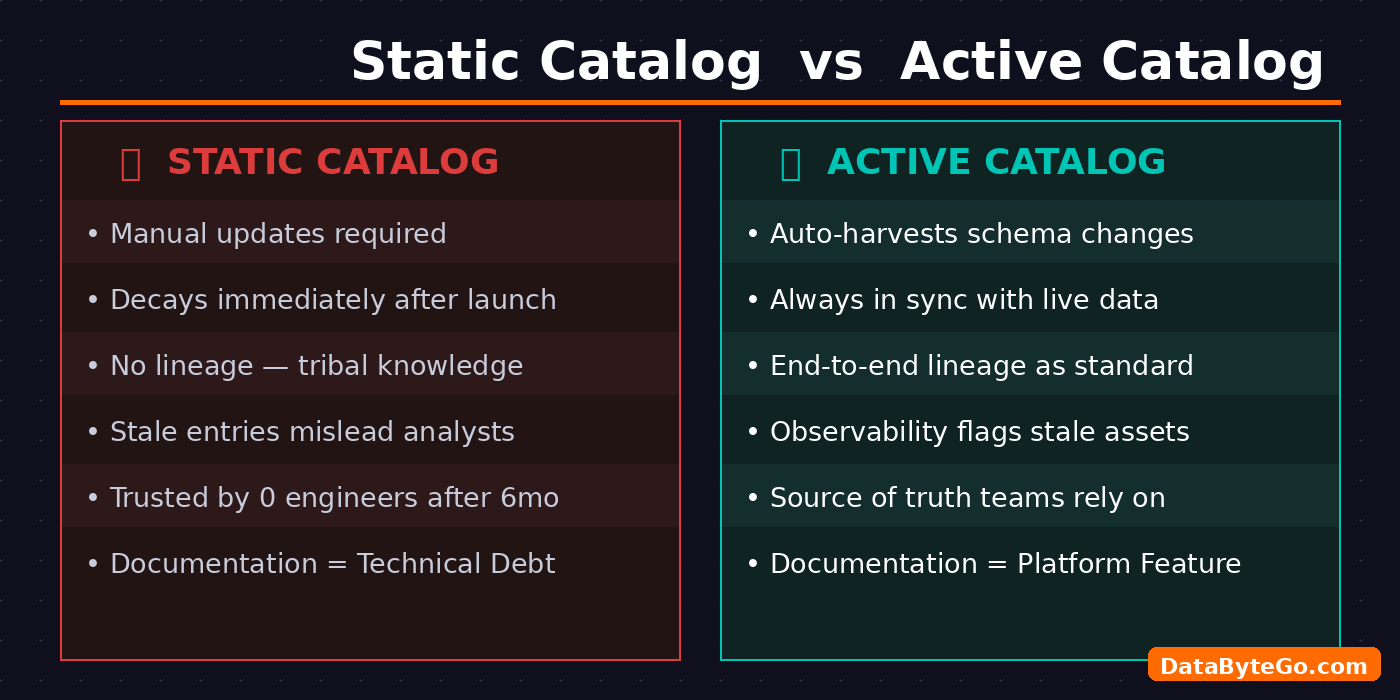
Static catalogs require humans to write and maintain metadata. That means every schema change, every pipeline refactor, every new table requires someone to update the catalog entry. In practice, nobody does
Code ships. Schemas evolve. Pipelines get rewritten. The catalog doesn’t move. What you’re left with is a growing gap between the documented version of your data and the actual, living version your teams are working with.
Sounds familiar? That’s because it’s the exact same failure mode as unmaintained code comments. And just like stale comments, stale catalog entries don’t just fail to help — they actively mislead.
Example: A data team at a retail company documents their orders table in their catalog with column definitions in January. By April, the engineering team has added five new columns, deprecated two, and renamed one. None of that is reflected in the catalog. An analyst uses the outdated documentation to write a revenue query that silently returns wrong results for three weeks.
2. The Trust Collapse
Stale metadata doesn’t just slow people down. It destroys trust in the catalog itself. Once engineers get burned a few times — following a catalog link to a deprecated table, or using documented column semantics that no longer apply — they stop using it.
The catalog becomes a ghost town. It still gets referenced in compliance audits and architecture reviews. But the actual day-to-day discovery work? It moves to Slack channels, tribal knowledge, and “ask the person who built it.”
Why does this matter? Because the informal knowledge networks that replace the catalog are invisible, unauditable, and non-transferable. Every time a key data engineer leaves, that network disappears with them.
“Once the catalog is wrong twice, it’s ignored forever. The real data dictionary lives in our team’s Slack and in three senior engineers’ heads. That’s not governance — that’s a bus factor of three.”
— Head of Data Engineering, Series D SaaS company
3. The Catalog Paradox
Here’s the cruel irony of the static catalog: the teams that need it most — the ones scaling fast, shipping frequently, with dozens of engineers touching data — are the least able to maintain it. Fast-moving teams produce the most metadata drift. Slow-moving teams have fewer changes to document, so their catalog stays reasonably accurate.
The result: the organizations investing in data products and platform engineering at scale are also the ones with the least reliable catalogs. The tool fails exactly where it’s needed most.
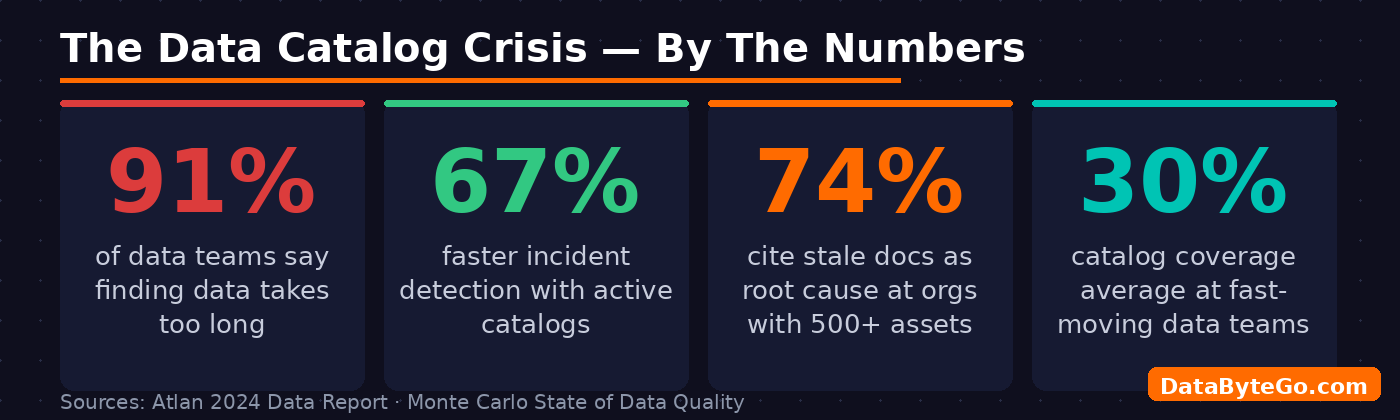
Stat: A 2024 Atlan report found that 91% of data teams report searching for data takes longer than it should — and over 60% cite outdated or missing catalog documentation as the primary cause. For organizations with more than 500 data assets, that number jumps to 74%.
Part 2: What an Active Data Catalog Actually Does
The answer isn’t to build a better static catalog. It’s to stop thinking about the catalog as a document and start thinking about it as a system. One that continuously observes your data environment and updates itself.
1. Automated Metadata Harvesting
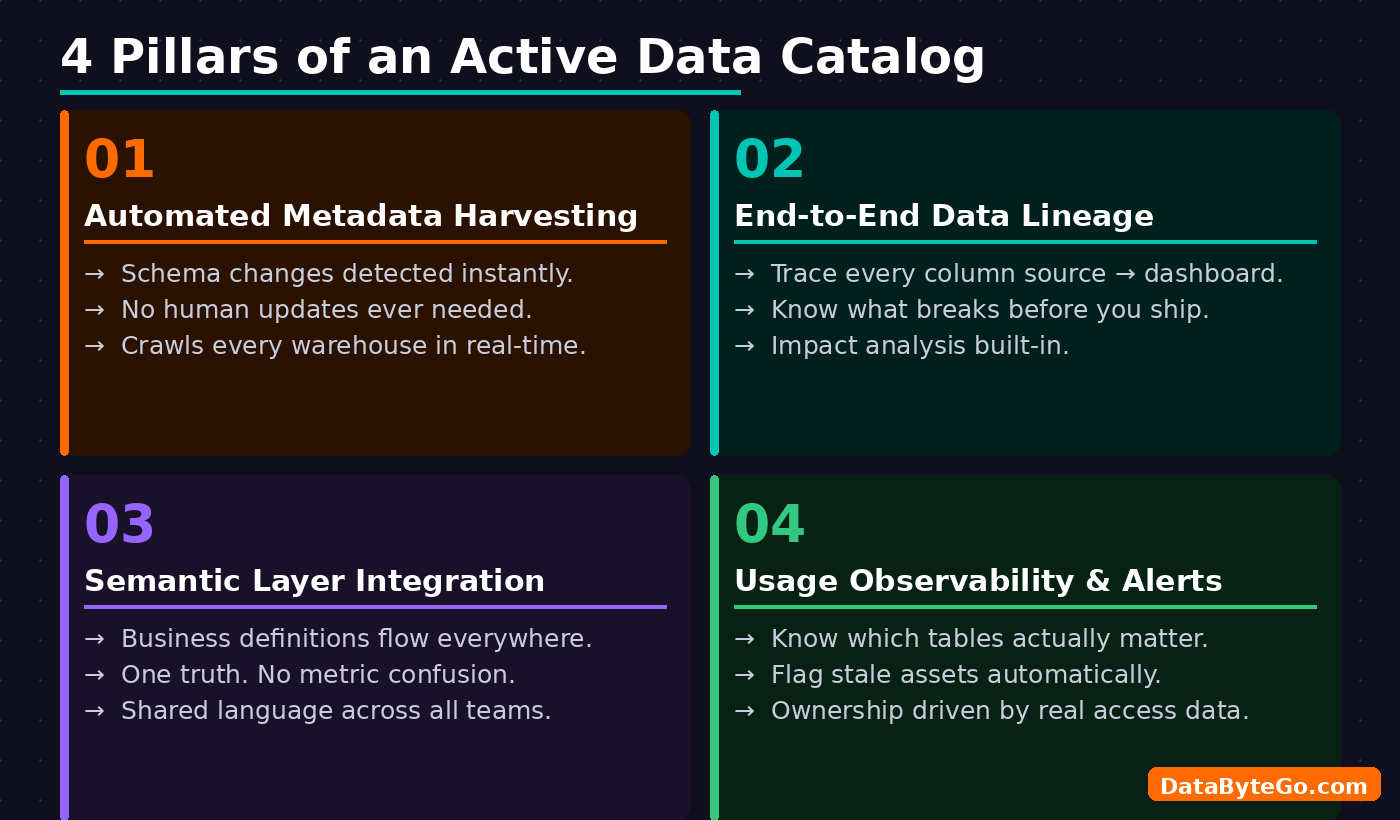
The first capability shift is automated schema crawling. Modern active catalogs connect directly to your warehouse, lakehouse, operational DB, and SaaS sources and continuously pull schema information, table statistics, column cardinality, and usage patterns.
No human writes a catalog entry. The system observes what exists, what’s being queried, and what’s changing — and generates a living documentation layer that moves as fast as your data does.
This eliminates the documentation-decay problem by design. If a column is renamed in Snowflake at 2 PM, the catalog reflects it by 2:05.
Example: Atlan, DataHub, and Alation all offer automated connectors that crawl schema changes, track column lineage, and flag orphaned assets. When a dbt model changes, the downstream catalog entries update automatically — including linked dashboards, definitions, and ownership metadata.
2. Lineage as a First-Class Citizen
A static catalog tells you what a table is. An active catalog tells you where it came from, what it feeds, and what breaks if it changes. That’s data lineage — and in 2026, it’s not optional.
End-to-end lineage traces data from source systems through transformations and into consumption layers (dashboards, ML models, APIs). It answers the questions that matter most during incidents: Which dashboards use this table? Who will be affected if we deprecate this column? How did this metric change?
Without lineage, data governance is reactive. With it, you can do impact analysis before you ship — not after something breaks in production.
3. Semantic Layer Integration
Metadata without meaning is noise. The active catalog should integrate with your semantic layer — the definitions that translate raw columns into business concepts. “revenue” isn’t a column name; it’s a concept with a precise, agreed-upon definition that should flow through every data product that references it.
When the catalog knows not just that orders.gmv exists, but that it maps to Gross Merchandise Value (pre-returns, pre-tax) as defined by Finance in Q1 planning — you have something that goes far beyond documentation. You have a shared language layer for your entire data platform.
“The catalog should be the contract between the people who build data and the people who use it. Not a wiki. A contract.”
4. Observability-Driven Documentation
Active catalogs don’t just document what exists — they observe how data is used. Usage analytics reveal which tables are actually being queried (vs. documented but never touched), which columns are relied upon by downstream consumers, and which assets are genuinely orphaned.
This observability layer transforms the catalog from a passive registry into an active intelligence platform. It can automatically surface high-value but undocumented assets, flag tables that haven’t been used in 90 days, and recommend ownership assignments based on query patterns.
Stat: Monte Carlo Data’s 2024 State of Data Quality report found that organizations using active observability-based catalogs reduced mean time to detect data incidents by 67% compared to teams using static catalog tools. The key differentiator: automated freshness monitoring and lineage-based impact analysis.
Part 3: Building the Active Catalog in Practice
The shift from static to active doesn’t require throwing away what you’ve built. It requires changing the underlying philosophy — from catalog-as-document to catalog-as-infrastructure. Here’s how to get there.
1. Treat Metadata Like Code
The most durable shift you can make is adopting metadata-as-code. Instead of catalog entries maintained through a UI, your table descriptions, ownership assignments, sensitivity classifications, and quality expectations live in version-controlled YAML files alongside your dbt models and pipeline definitions.
When code ships, metadata ships with it. CI/CD pipelines validate that catalog entries are present and accurate before a model hits production. A PR without updated metadata fails the pipeline. Documentation drift becomes structurally impossible.
Tools like dbt’s schema.yml, Atlan’s metadata API, and DataHub’s metadata ingestion framework all support this pattern. The tooling exists. The discipline is the gap.
Example: A platform team at a fintech company adds a dbt schema.yml lint check to their CI pipeline. Every model must have a description, owner, freshness SLA, and sensitivity tag before merging. The rule is simple: no metadata, no merge. In six months, catalog coverage goes from 30% to 97%.
2. Use ML-Assisted Classification to Bootstrap Coverage
If your catalog is years of technical debt behind, starting from scratch isn’t realistic. The practical shortcut is ML-assisted metadata generation. Modern catalog tools can analyze column names, data types, value distributions, and sample values to automatically suggest descriptions, sensitivity classifications, and data categories.
This isn’t set-and-forget. The ML suggestions are starting points for human review, not final answers. But bootstrapping 10,000 table entries in a day rather than a year fundamentally changes what’s possible.
PII detection is the most important use case. A column named usr_email_addr or containing values that match email patterns should be automatically flagged for sensitivity review, not missed because nobody got around to tagging it manually.
3. Make Data Products the Unit of Governance
The deepest architectural fix isn’t a catalog tool choice — it’s a data product orientation. When data is managed as products (with owners, SLAs, consumers, and contracts) rather than as infrastructure, governance naturally follows the work.
A data product owner is accountable not just for delivering a dataset, but for keeping its documentation current. The catalog entry for a data product isn’t a nice-to-have; it’s part of the product’s definition of done. It’s what consumers rely on. It’s what the SLA is measured against.
This is the governance model that actually scales. Not top-down mandates to fill in catalog fields. Ownership-driven accountability where documentation is a product quality metric, not an administrative burden.
Example: A data mesh team at a large insurance company defines “catalog completeness” as one of four quality metrics on their data product scorecards. Each domain team’s platform health is tracked publicly. Within two quarters, stale catalog entries drop from 68% to 11% — not because of a mandate, but because nobody wants a red metric on the public dashboard.
The Catalog Is Not Dead — the Static Catalog Is
The data catalog isn’t the wrong idea. It’s one of the most important ideas in modern data infrastructure. But the implementation model — manual curation, periodic updates, wiki-style documentation — was wrong from the start.
In 2026, your data platform moves faster than any human can document it. The only viable answer is a catalog that keeps up automatically — through automated crawling, lineage tracking, usage observability, and metadata-as-code pipelines.
Teams that make this shift will find that discoverability, governance, and trust in data become emergent properties of the platform rather than quarterly documentation initiatives.
Teams that don’t will spend 2026 the same way they spent 2022: explaining why the catalog is wrong, answering the same Slack questions about where the dataset lives, and watching their data debt compound in the one place nobody thinks to look
Key Takeaways:
Static catalogs decay by default. They require constant human maintenance to stay accurate — a model that fails at scale.
Active catalogs observe and update automatically. Schema crawling, lineage tracking, and usage analytics create documentation that keeps pace with your data.
Metadata-as-code eliminates drift. Treat catalog entries like code: version-controlled, CI/CD-validated, and required to ship.
Data products make governance scale. Ownership accountability turns documentation from an admin task into a product quality metric.